 2026.09.02
 Noticias de la industria
Contenido
In any production environment that relies on molds—injection molding, die-casting, stamping, or rubber forming—the mold room can become a bottleneck. Operators constantly walk between storage racks and presses, trying to locate a specific mold, then struggle to pull it off a fixed shelf without scratching the tool or straining their backs. The result is wasted time, damaged molds, and unnecessary safety risk.
The drawer-type mould rack changes that dynamic. Instead of a fixed shelf or a simple open frame, each storage level is a drawer that can be pulled out independently. This means the operator can bring the mold to a position where a workshop crane or electric hoist can easily lift it, without entering the rack or reaching over other molds. For molds that weigh several hundred kilograms, this is not a nice-to-have—it is an operational necessity.
Before looking at specifications, the conclusion is straightforward: for any shop that handles molds weighing more than 200 kg on a regular basis, a drawer type rack is the safest and most efficient choice.
The core benefit is independence. With a normal rack, retrieving a mold buried at the back means moving every mold in front of it. With a drawer rack, the operator simply pulls out the required drawer. The drawer moves on heavy-duty guide rails, often supported by ball bearings, so the pull-out force remains manageable even with a heavy load. Once extended, the mold can be hooked to an overhead hoist and lifted straight out.
This approach also protects the mold. Repeated manual sliding or dragging across steel beams causes tiny scratches and dents that eventually reduce mold quality. Because the drawer keeps the mold on a flat, controlled surface, the chance of impact damage is far lower. For precision molds that cost tens of thousands of dollars, this protection alone can justify the investment.
Space efficiency is another major factor. Drawer racks stack vertically, so a single rack can store many molds in the footprint of a few square meters. The pull-out design eliminates the need for extra walkways or clearances for forklift access—the operator stays in front of the rack.
Consider a typical injection molding plant with 40 molds in daily rotation. Without a drawer rack, the operator might spend 15 minutes per mold change just locating and retrieving the mold. With a drawer rack, that time drops to under five minutes. If the plant does eight mold changes per shift, the daily time savings is over an hour—and that does not include the avoided mold damage.
Our drawer-type mould tooling rack is engineered with these workflow realities in mind, using high-strength steel and precision-machined guide systems to handle repeated daily use.
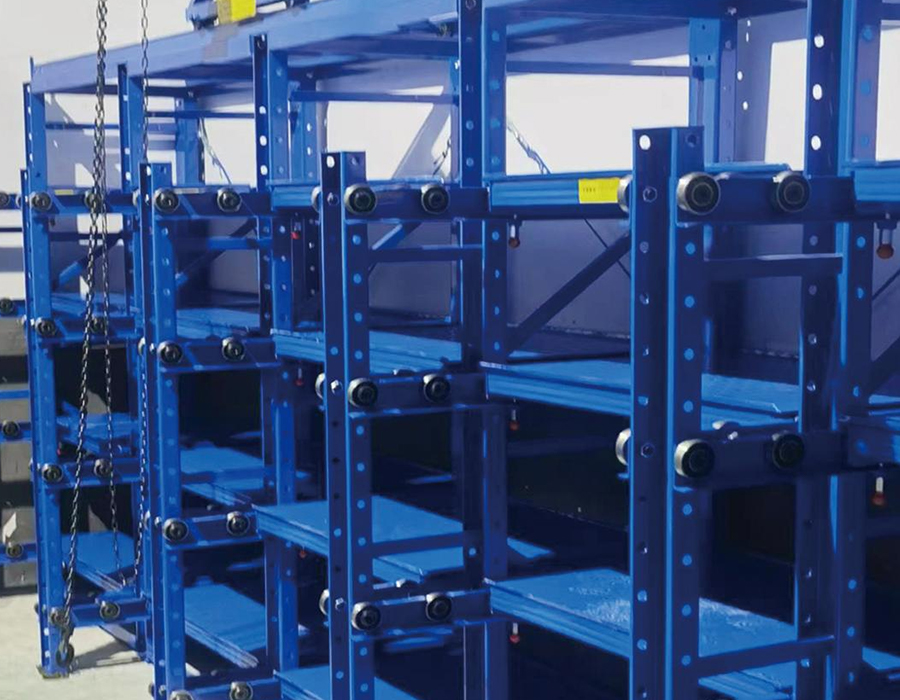 Drawer-Type Mold Rack with High-Strength Steel and Safety Features This rack offers organized storage with load capacities up to 3,000 kg per drawer and an integral hoist option, making it ideal for heavy mold handling and safe retrieval in manufacturing settings. View Product →
 Selecting the right mould rack begins with load calculations. Every drawer has a rated maximum load, and that rating must account for the mold plus its base plate or carrier. For heavier molds, you also need to consider the full drawer extension—a rack that only pulls out 60% may not give the hoist enough clearance to lift the mold safely.
Other critical factors include drawer width and depth, the number of drawers per column, and the total height of the rack. In many workshops, ceiling height is the limiting factor, so the rack must be designed to fit under overhead equipment. The pull-out stroke should be smooth and stable even at full extension, without sagging.
When comparing suppliers, ask how the drawer guides handle point loads. A 1000 kg mold resting on two rails creates concentrated forces that can cause premature wear if the guides are not properly heat-treated or if the rail thickness is too thin. A safety margin of at least 20% above the actual mold weight is a reasonable rule of thumb.
A second consideration is operating equipment. Many drawer racks are designed to work with an electric hoist or a jib crane installed above the rack. If your facility has a crane already, the rack should be placed so the crane can reach all drawers. If not, a lightweight chain hoist on a monorail can be incorporated into the rack structure. This integration reduces the effort required to load and unload molds, and it significantly lowers the risk of back injuries.
Also consider the maintenance side. The drawer guides, wheels, and locking mechanisms will wear over time. A rack that uses standardized, replaceable components is easier to maintain than one with proprietary parts. The total cost of ownership depends as much on these details as on the initial purchase price.
Every mold room has unique constraints—different mold sizes, specialized lifting requirements, or limited floor space. A manufacturer that only produces standard sizes may not be able to solve these problems. That is why vertically integrated production matters.
Huijian Intelligent operates a 1,500-square-meter R&D center and owns 58,000 square meters of factory space in Guangde, with six production lines and an annual capacity of 180,000 sets of warehouse racks. The company follows the ISO 9001:2015 quality management system, with inspections at incoming raw materials, in-process manufacturing, and final shipment. This level of control allows engineers to adjust drawer dimensions, load ratings, and pull-out mechanisms based on the actual mold data you provide.
For a detailed discussion of why dedicated mold storage equipment is gaining popularity in factories, you can read our industry update on this topic.
Ultimately, a drawer-type mould rack is not just a shelf—it is a tool that helps your production team work faster, safer, and with less risk to the molds that keep your machines running. By focusing on load capacity, drawer guidance, and integration with your lifting equipment, you can make a choice that pays back in reduced downtime and longer mold life.
Nuestro equipo profesional
está listo para apoyarle.





 English
 Español